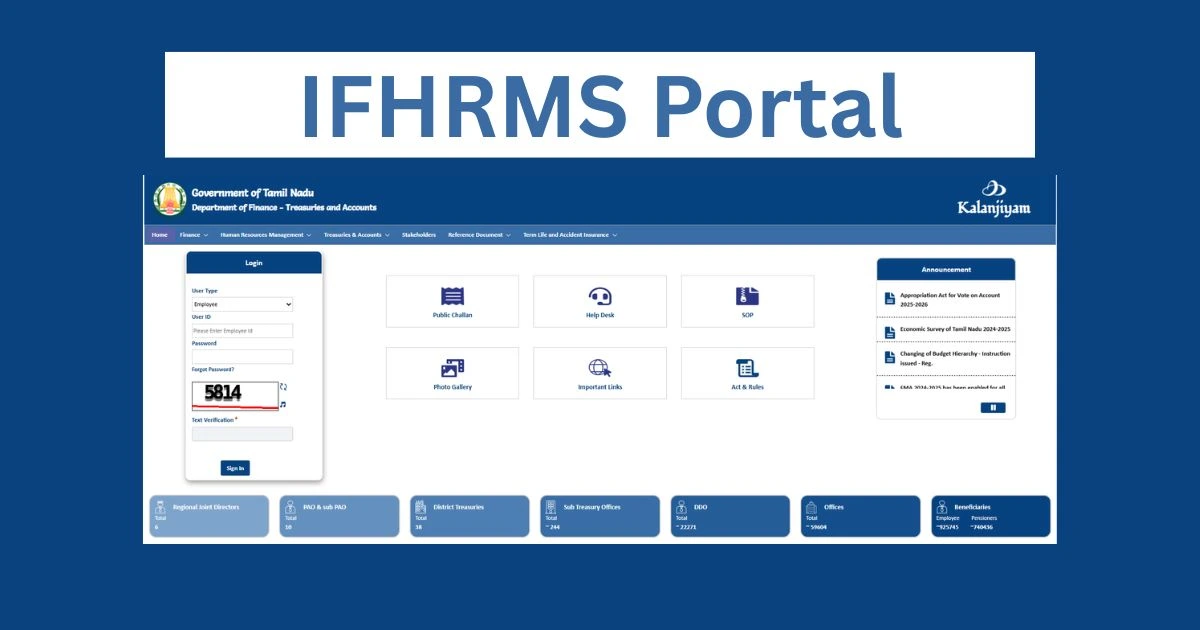
The public sector is experiencing a “silent revolution” through the impact of this digital change, which is transforming Government (especially in India) through an extensive, integrated solution for millions of Government Employee’s lives and the Ministries who support them through their employment and administration. This technological advancement is referred to as the Integrated Financial and Human Resource Management System or IFHRM system.
You may have heard about IFHRMS from colleagues or Government Officials. You have probably seen something about IFHRMS in either an official document. Maybe you even have seen the IFHRMS logo on your next paycheck? So what is IFHRMS? Why was it implemented? How is it going to help you as an Employee? This document will include details of IFHRMS, including a summary of the primary functions of IFHRMS, the main advantages of IFHRMS, and frequently asked questions regarding IFHRMS.
What is IFHRMS?
In basic terms, IFHRMS is a web-based software application that incorporates all aspects and processes of the Finance and Human Resource (HR) functions of government. In many ways, it is comparable to a world-class Enterprise Resource Planning (ERP) application developed by multinationals.
The term ‘integrated’ refers to the development of the Integrated Federal Human Resource Management System. Prior to IFHRMS implementation, the various departments of the government worked independently. Human Resources maintained paper service books, while finance used different software to manage salaries and payments. In addition, each entity had an outdated system for processing each of its own services. With these processes in place, there were multiple duplicative entries, and it took time and caused significant frustration to reconcile errors across departments.
IFHRMS destroys the individuality of each department and creates a complete view of the services and the information that supports each department through a single source of truth. IFHRMS is constructed on a basis of sound technology, utilizing numerous applications from leading software companies for example, Oracle ERP Systems, and has been designed to manage all facets of the employee experience. From job recruitment and hiring to payroll and promotions, employee transfer or relocation, and finally to
retirement and pension payments.
Core Vision: Asa result of the implementation of IFHRMS, the government will realize transparency, accountability, efficiency and the empowerment of its employees. Through IFHRMS, we can eliminate red tape through the use of electronic work flow; eliminate paper files through the use of electronic files; and remove uncertainty through
real-time access to data.
Benefits of IFHRMS
IFHRMS creates positive results for every participant in the government ecosystem. The implementation of IFHRMS will create benefits for all the stakeholders within government operations.
For Employees of Government:
- Salary and pension calculations are carried out automatically. Employees’ allowances, deductions, loans, and increments are calculated by the system and their salary will be credited on their last working day of the month. Pensioners will receive their pensions without any hassle.
- The Self Service Portal provides employees with immediate access to their MSS, allowing them to perform the following functions 24 hours a day, 7 days a week. Employees may:
- View and/or download, as needed, their pay slips, Form 16 and other income statements.
- Apply online for Earned, Casual, Sick Leave and monitor the status of their leave application.
- View a complete digital Service Book containing their entire service history.
- View their General Provident Fund (GPF) statement and loan status.
- Update their Basic Details as well as Nomination details.
- The Service Portal has provided transparency into all matters of service to employees. Employees previously had to make anxious trips to administration in order to learn the status of their promotion, transfer, and/or increment. Now, employees can view all aspects of their service through the service portal.
- When employees wish to apply for a GPF loan, house building advance, or motor car advance, applying for these advances has become a simple online procedure. Employees no longer have to contend with large volumes of paper work and follow-up calls.
Benefits for Government Administration:
- Paperwork Reductions on a Drastic Scale: The IFHRMS automates the process of generating leave applications, travel allowance requests and other business applications. All of these processes are routed electronically for approval, saving time and money in physical storage and resource allocation. Additionally, IFHRMS will provide the user with destination and expected expense reports for travel requests.
- Data-Driven Decisions: The IFHRMS generates massive amounts of real-time data and analytics to enable administrators to better manage and allocate resources to include: manpower distribution, vacant positions, budget utilization, and trends in employee leave or transfer requests.
- Increased Compliance and Internal Control: Since all processes are embedded with the Government’s rules and financial regulations through IFHRMS, there will be less chance for manual error or procedural violations within a traditionally handbook-driven environment. Therefore, the use of the IFHRMS will also increase the internal controls and audit capabilities of the Government.
- Cadres and Vacancies will be Managed More Efficiently: The IFHRMS will significantly improve the methods for tracking vacancies and managing deputations of Government employees, as well as keeping up-to-date records of the seniority lists of complex cadres.
Historic Milestones of the IFHRMS Initiative
The implementation of the IFHRMS project across multiple states and Central departments is a historic achievement within itself with respect to its large size and complexity. In fact, it is one of the largest and longest comprehensive digital government initiatives completed.
- Consolidated Platform for Millions of Employees: The IFHRMS will successfully consolidate all data and processes for millions of employees on a single consolidated platform, providing uniform processes and methods where there were previously many separate, disconnected systems.
- Direct Benefit Transfer Integration: By Connecting with the Direct Benefit Transfer (DBT) system, IFHRMS Guarantees the Direct Deposit of Employees' Salaries and Pensions into their Bank Accounts that are connected to their Aadhaar Numbers, thus eliminating any Delays or Losses in Salary and Pension Payments.
- Integration with Other National Portals: IFHRMS is not Stand-Alone; it is integrated into Other Important National Systems, such as the PFMS (Public Financial Management System) for Treasury Management and the NPS (National Pension System) for New Hires, to create a Comprehensive Financial Governance Framework.
- e-Service Book: One of the Game-Changing Features of IFHRMS is a Digital Life-Long, Tamper-Free Service Book. This Book Contains All of an Employee’s Career Records in One Place, and it is easily Transferable; thus, there is no Longer the Risk of Losing a Paper Service Book.
- Foundation for Future Technologies: IFHRMS Establishes the Foundation for Using Advanced Technologies, Such as Artificial Intelligence and Predictive Analytics, Which Will Allow for the Identification of Employee Training Needs and the Best Use of Skilled Resources in Business Operations.
How to Access IFHRMS
Employees will primarily access IFHRMS through the Self-Service Portal (SSP). A Common Workflow for Using the SSP is:
- After logging in with your Employee ID and password, you will see a user-friendly dashboard that includes the following menu options: Pay Slip, Service Book, Leave, GPF, Loans and Advances, and Profile.
- Viewing Your Pay Slip: Once in the Pay Slip module, select the month and year you want to view and either print out or save the slip as a PDF. You will no longer have to wait for your physical pay slip to arrive in the mail.
- Applying for Leave: Once in the Leave module, you will be able to see your available leave balance. To apply for leave, select the type of leave and enter the appropriate dates, then submit your leave request electronically through the Leave Module. Leave requests will be electronically routed to your Reporting Officer and Accepting Authority, where they will either approve or reject the leave request. You may check the status of your leave application from applied to approved or rejected.
- Accessing Your Service Book: Once in the Service Book module, you will be able to view all postings, including promotions, pay revisions, and your personal profile. All information in this module is read-only for employees.
- Viewing Your GPF: The GPF module has a complete accounting of how many subscriptions and withdrawals you have made to date, and your current balance.
- Updating Profile: You may change specific information in your profile, like your phone number, email address, or mailing address. The information will then be verified and approved by the admin before being applied.
FAQs
Q1: HELP! My password has been forgotten. What should I do?
Most IFHRMS Portals have a "Forgot Password" link located on the login page. This will allow you to reset your password via an OTP sent to your registered mobile phone or email address. If this does not work, please reach out to your department's nodal officer or the IT help desk for assistance.
Q2: I noticed that there was an error with my payslip (ex: wrong deduction, missing allowance). How do I correct it?
The IFHRMS is an automated system; however, it runs on data entered by the Drawing and Disbursing Officer (DDO) in each department. You should report the error to your DDO or to the Administrative Section as they are responsible for verifying and correcting the information in the system for the following month.
Q3: My supervisor rejected my leave application. Can I submit another one?
Yes. Your leave application will display the reason(s) for rejection. You may edit and resubmit your leave application, based on the comment(s) from your supervisor, through the IFHRMS Portal.
Q4: Is IFHRMS data safeguarded and preserved for future generations?
The system is protected by secure government internet servers and various security protocols, such as role-based access and encryption. Digital records are likely to be more protected than physical record because physical records are much more vulnerable.
Q5: I am nearing retirement; how does IFHRMS assist with my pension applications?
Once you reach your retirement and request your pension, IFHRMS contains a pension module that notifies the administration to begin processing your pension documentation (PPO). Additionally, your complete electronic service record is utilized to calculate your retirement benefits (pension and gratuity) to enable a quicker processing of those benefits and guarantee you receive your first pension payment on your retirement date.
Q6: Am I able to view IFHRMS on my mobile device?
The primary method of accessing IFHRMS is through a Web-based application, although some states are currently creating and offering an IFHRMS mobile application to give state employees a more accessible means of accessing their records remotely.